Chasing Desert Gold: How Arizona's Landscape Transforms During the Hour of Perfect Light
There is a particular quality to Arizona's light that seasoned photographers recognize immediately — a warmth that feels almost tangible, a depth that seems to press itself into the sandstone and saguaro alike. While golden hour is a phenomenon experienced across the globe, Arizona's unique combination of high-altitude desert terrain, low atmospheric humidity, and sweeping open vistas elevates this daily event into something that borders on the cinematic. For photographers seeking to capture images that resonate with genuine emotional weight, understanding how to work within Arizona's specific environment during these transitional moments of light is not merely advantageous — it is essential.
Why Arizona's Desert Amplifies Golden Hour Light
The science behind golden hour is straightforward: as the sun approaches the horizon, its light travels through a greater thickness of atmosphere, scattering shorter blue wavelengths and allowing the longer red, orange, and gold wavelengths to dominate. What makes Arizona exceptional is the degree to which its environment intensifies this process.
The state's characteristically dry air contains minimal moisture and particulate matter compared to coastal or forested regions. This clarity allows golden hour light to arrive with remarkable purity, reducing the haze that often softens — and sometimes muddies — the warm tones photographers seek. Additionally, Arizona's varied elevations, which range from roughly 100 feet above sea level in the Sonoran Desert to over 12,000 feet in the San Francisco Peaks near Flagstaff, create microclimates and atmospheric conditions that alter the character of light from one location to the next. A golden hour shoot in Sedona feels categorically different from one conducted in the Tucson basin, even when both sessions occur on the same evening.
The state's iconic red and ochre rock formations also serve as natural light amplifiers. Iron oxide minerals embedded within sandstone and limestone absorb and re-emit warm wavelengths, producing a secondary glow that extends the effective golden hour window by several minutes on either side of the theoretical calculation.
Sedona: Where Rock and Light Converge
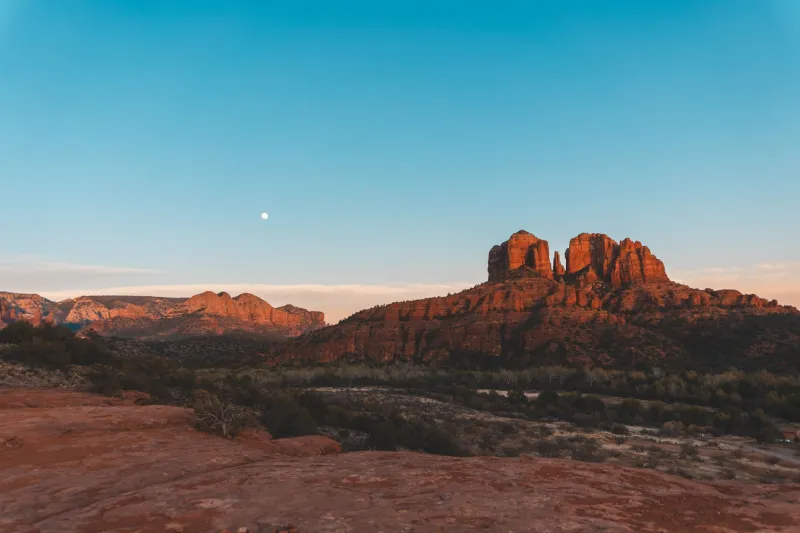
Few destinations in the American Southwest rival Sedona for golden hour photography. The city sits within a basin of towering red rock buttes — Cathedral Rock, Bell Rock, Courthouse Butte, and the Coffeepot formation among them — that respond to transitional light with an almost theatrical intensity.
The most productive shooting locations in Sedona during golden hour include the Cathedral Rock crossing at Red Rock Crossing, where Oak Creek provides reflective foreground interest, and the Airport Mesa overlook, which delivers a panoramic perspective of the entire formation cluster. Photographers working the morning golden hour should position themselves on the western faces of formations to catch the first direct light, while evening sessions reward those who move to eastern vantage points as the sun descends behind the western ridgeline.
Sedona's elevation — approximately 4,350 feet — means that the atmosphere above the formations is thinner than at lower desert elevations, producing a color rendering that tends toward the deeply saturated rather than the softly diffuse. Expect vivid contrast between shadow and highlight, which demands careful exposure management.
Monument Valley: Scale, Shadow, and Silence
Located on the Arizona-Utah border within the Navajo Nation, Monument Valley presents a fundamentally different compositional challenge. Here, the landscape is defined by scale — the Mittens, Merrick Butte, and the Three Sisters formations rise hundreds of feet from a flat, rust-colored plain, and golden hour transforms them into monolithic silhouettes or incandescent towers depending on the viewer's angle relative to the sun.
Photographers visiting Monument Valley should be aware that much of the park requires guided access, and working with a licensed Navajo guide is both a legal requirement for venturing beyond the 17-mile scenic drive and a professional responsibility. Guides frequently possess intimate knowledge of lesser-known vantage points that produce images of considerable distinction.
The extended twilight that follows sunset in Monument Valley — owing to the valley's open horizon and the absence of obstructing terrain — offers an additional window of usable warm light that can last 20 to 30 minutes beyond the sun's disappearance. This period, sometimes called the blue-gold transition, produces a layered atmospheric effect that is particularly well-suited to long-exposure work.
Phoenix: Urban Geometry Meets Desert Warmth
Phoenix presents a compelling case for golden hour photography that is often underestimated by photographers fixated on natural landscapes. The metropolitan area's grid of glass towers, angular residential architecture, and canal infrastructure catches warm light in ways that create distinctly Arizonan urban images.
The South Mountain Park and Preserve, which borders the southern edge of the city, offers elevated vantage points from which the entire Phoenix skyline can be framed against a golden or deep amber sky. The Papago Park buttes, located closer to the urban core, provide a foreground element that bridges the gap between natural and built environments — a compositional approach well-suited to editorial and commercial photography.
For photographers working in Phoenix's urban environment, the summer monsoon season — typically July through September — introduces dramatic cloud formations that interact with golden hour light in extraordinary ways. Towering cumulus and cumulonimbus clouds catch warm light at their upper edges while casting deep shadows across the valley floor, creating high-contrast scenes that reward photographers willing to work in warm, humid conditions.
Seasonal Considerations for Golden Hour Timing
Arizona's golden hour does not behave identically throughout the year, and understanding seasonal variation is critical for planning professional shoots.
Winter months — November through February — offer the longest and most gradual golden hours, as the sun's lower arc across the sky extends the transitional light period. Temperatures at elevation, particularly in Sedona and Flagstaff, can drop sharply after sunset, requiring photographers to protect both themselves and their equipment from cold and potential frost.
Summer months produce shorter, more intense golden hours due to the sun's higher trajectory, but the monsoon season introduces the cloud dynamics mentioned above, which can transform an otherwise unremarkable evening into an extraordinary photographic event. Spring and fall represent something of a middle ground — moderate temperatures, reliable skies, and golden hour durations that allow for deliberate compositional work without the urgency of winter's rapid transitions.
Technical Settings for Arizona's High-Desert Light
The intensity and contrast of Arizona's golden hour light demand specific technical approaches. A general starting point for most desert landscape work involves an ISO between 100 and 400 to preserve maximum dynamic range, apertures in the f/8 to f/16 range to maintain sharpness across deep focal planes, and shutter speeds determined by available light and the presence or absence of motion in the frame.
Exposure bracketing is strongly recommended in high-contrast situations — particularly when shooting formations that are simultaneously illuminated and shadowed — as the dynamic range of even professional-grade sensors can be challenged by Arizona's extremes. A graduated neutral density filter is an invaluable tool for balancing bright skies against darker foregrounds, and a circular polarizer can reduce the glare that sometimes diminishes color saturation on rock surfaces.
White balance should be set manually or adjusted in post-processing with restraint. Arizona's golden hour light is inherently warm, and overcorrecting toward neutral tones removes the very quality that makes these images compelling.
For photographers seeking to distinguish their work in Arizona's competitive landscape photography market, the golden hour is not simply a time of day — it is a medium in its own right, one that rewards preparation, technical fluency, and a genuine attentiveness to the land itself.