Poise, Performance, and the Perfect Frame: The Demanding Art of Competition Photography in Arizona
Arizona's pageant, dance, and amateur competition circuits demand a photographer who can do far more than press a shutter at the right moment. The images produced in these high-stakes environments serve contestants long after the trophies are awarded, shaping portfolios, building confidence, and opening doors in entertainment, athletics, and professional life. Understanding what separates adequate competition photography from truly exceptional work requires a close look at the craft, the culture, and the considerable technical demands involved.
A Market More Complex Than It Appears
At first glance, competition photography might seem straightforward — show up, aim the camera at the stage, and capture the action. In practice, the discipline is among the most technically and emotionally demanding specialties in the commercial photography world. Arizona hosts hundreds of organized competitions annually, from youth dance showcases in Scottsdale and Mesa to scholarship pageants in Phoenix, cheer championships in Tempe, and amateur athletic events across the greater metropolitan region and beyond into Tucson and Flagstaff.
Each of these events carries enormous personal stakes for participants. A teenager stepping onto a pageant stage for the first time is not simply performing — she is presenting an identity, testing her self-perception, and often auditioning for a future she has not yet fully imagined. A competitive dancer who has trained for years wants proof that the thousands of hours of practice translated into visible artistry. A young athlete competing in a regional tournament deserves imagery that reflects the discipline and determination that brought him to that moment. The photographer who understands this emotional weight brings an entirely different quality of attention to the work.
Technical Challenges Unique to Competition Environments
Competition venues in Arizona present a consistent set of photographic challenges that demand professional-grade solutions. Stage lighting is the most persistent obstacle. Event organizers prioritize visibility for judges and audiences, not for camera sensors. The result is frequently a harsh combination of overhead spotlights, colored gels, and underlit backgrounds that can flatten subjects, distort skin tones, and create unflattering shadows.
An experienced competition photographer arrives with this reality fully anticipated. Fast prime lenses with wide apertures — typically f/1.8 or f/2.8 — allow for adequate exposure without pushing ISO values into noise-generating territory. Bodies with strong low-light performance are selected deliberately. White balance is set manually or adjusted in post-processing with careful attention to preserving natural skin tones against the artificial warmth or cool of stage lighting.
Motion is the second major variable. Dance competitions require the photographer to anticipate movement rather than simply react to it. Capturing the apex of a leap — the precise instant when the dancer is fully extended and the motion appears suspended — demands both technical knowledge and deep familiarity with choreography conventions. Continuous burst modes help, but experience matters more. A photographer who understands the structure of a jazz routine or a lyrical piece will position correctly and time the shutter with intention, not luck.
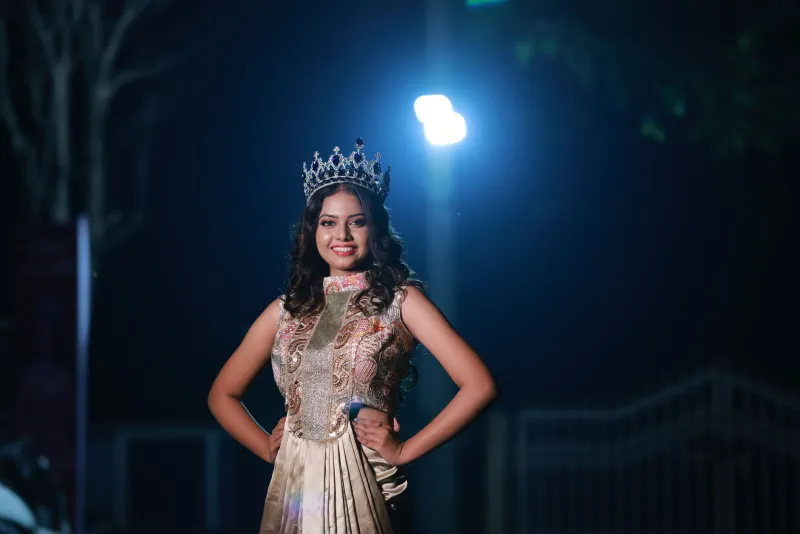
Pageant photography introduces different challenges. Contestants move across stages, pause at designated marks, interact with hosts and judges, and transition between categories — often in rapid succession. The photographer must track multiple subjects simultaneously while reading the emotional dynamics of each moment. A genuine smile during an interview segment carries far more commercial value than a posed grin, and capturing that authenticity requires patience, positioning, and an almost journalistic instinct for the decisive moment.
The Dual Purpose of Competition Images
What distinguishes professional competition photography from casual event snapshots is an understanding of how the resulting images will be used. In most cases, competition photographs serve two distinct functions simultaneously.
The first is documentation — creating a visual record of the event itself for contestants, families, and organizations. These images carry sentimental value and serve as milestones in a participant's development. Parents in Chandler or Gilbert who watch their child perform at a regional competition want photographs that honor the significance of that experience.
The second function is professional portfolio development. For pageant contestants, high-quality competition images are often submitted to talent agencies, scholarship committees, and modeling representatives. For dancers, competition photographs may accompany applications to performing arts programs or professional companies. For athletes, strong action imagery supports recruitment profiles and sponsorship conversations. When a photographer approaches competition work with this second function in mind, the framing, lighting choices, and moment selection all shift toward images that project competence, confidence, and authenticity in equal measure.
This dual purpose is not a burden — it is the factor that elevates the work from event coverage to genuine commercial photography. The best competition photographers in Arizona operate with the same intentionality as a corporate portrait specialist or an editorial photographer, because the downstream value of their images demands it.
Confidence as a Photographic Subject
One of the most compelling and underappreciated aspects of competition photography is its role in shaping how participants perceive themselves. A contestant who sees a well-crafted image of herself at her best — poised, expressive, and commanding the frame — carries that visual reference forward. It becomes part of how she understands her own capability.
This is not a trivial outcome. Experienced competition photographers in Arizona understand that their work has a formative dimension, particularly for younger participants. The decision to include an image where a dancer's expression reveals genuine joy rather than practiced performance, or to select the frame where a pageant contestant's confidence reads as entirely natural, reflects a commitment to authenticity that serves subjects far beyond the competition itself.
Building this kind of trust requires communication before the shutter is ever pressed. A pre-event conversation with contestants, parents, or event coordinators establishes expectations, identifies key moments to prioritize, and allows the photographer to understand each subject's goals. This preparation is not optional — it is the foundation of images that actually serve the people in them.
Arizona's Competition Culture and the Photography It Deserves
Arizona's warm climate, large metropolitan population, and strong tradition of youth arts and athletics programs create a genuinely vibrant competition culture. Events run year-round in ways that would be impossible in colder states, and the diversity of disciplines — from traditional pageantry to contemporary dance, from martial arts tournaments to equestrian competitions — means that photographers who specialize in this space encounter an unusually wide range of subjects and environments.
For businesses and organizations running these events, professional photography is also a marketing asset. Well-executed competition images populate websites, social media channels, and promotional materials in ways that directly influence registration numbers and sponsor interest. The photographs taken at this year's event are recruiting tools for next year's participants.
For contestants and their families, the investment in professional competition photography is an investment in how they present themselves to the world. In Arizona's competitive environment — whether on a pageant stage in Peoria or a dance floor in Tempe — that presentation matters enormously.
The photographers who understand this, who arrive prepared for the technical demands and attuned to the emotional stakes, are the ones producing images that genuinely serve their subjects. That is, ultimately, the standard that competition photography in Arizona must meet.