Illuminating Discovery: How Arizona's Research Institutions Use Scientific Photography to Compete for Talent, Investment, and Prestige
The experiment that could yield a breakthrough cancer diagnostic, the microscopic structure that holds the key to a more efficient solar cell, the laboratory environment where a team of researchers is quietly reshaping the boundaries of materials science—these are the stories that Arizona's research institutions and biotech companies need to tell. The challenge is that the most significant scientific work often takes place at scales, in environments, and through processes that are inherently resistant to casual visual documentation.
Specialized scientific and laboratory photography exists precisely to close that gap. Across the Phoenix metropolitan area, the Tucson research corridor, and the university campuses that anchor Arizona's knowledge economy, professional photographers with technical training are helping institutions translate the language of science into imagery that communicates with investors, recruits graduate students, and builds the kind of public profile that sustains long-term institutional growth.
The Stakes of Scientific Visibility
Arizona's research ecosystem is competitive in ways that extend well beyond the laboratory bench. The state's three public research universities—Arizona State University, the University of Arizona, and Northern Arizona University—compete nationally for federal grant funding, corporate research partnerships, and the graduate students and faculty whose work drives institutional reputation. The biotech and life sciences companies clustering around the Phoenix Biomedical Campus and the University of Arizona Tech Park compete for venture capital, skilled workforce talent, and the strategic partnerships that accelerate commercialization.
In each of these competitive arenas, visual presentation matters more than many research administrators have historically recognized. A federal grant application supported by compelling imagery of laboratory facilities and research teams communicates institutional capacity in ways that text-based narratives cannot replicate. A biotech company's investor pitch deck anchored by professional photography of its laboratory environment and scientific process conveys a seriousness of purpose that stock photography simply cannot approximate.
The institutions that have invested in professional scientific photography consistently report that the returns extend across multiple dimensions: improved grant application success rates, stronger recruitment outcomes, elevated media coverage, and enhanced donor engagement. The photography pays for itself many times over—not as a marketing expense, but as a strategic investment in institutional visibility.
The Technical Complexity of Laboratory Photography
Photographing scientific environments presents a set of technical challenges that distinguish this specialty from conventional commercial photography. Laboratory spaces are rarely designed with visual documentation in mind. Fluorescent overhead lighting creates color casts that must be corrected or supplemented. Biosafety cabinets, fume hoods, and specialized equipment create physical constraints that limit camera positioning and require creative solutions to achieve compositions that are both accurate and visually engaging.
Microscopic photography—capturing the imagery that scientists themselves generate through electron microscopes, confocal microscopes, and other imaging instruments—represents a distinct subspecialty with its own technical requirements. False-color scientific images, which assign visible colors to structures that exist at wavelengths invisible to the human eye, must be handled with particular care when used in public-facing communications. Photographers and communications staff working together must ensure that these images are contextualized in ways that are scientifically honest while remaining visually accessible to non-specialist audiences.
Process photography—documenting the sequential steps of a research protocol or manufacturing procedure—requires the photographer to develop sufficient understanding of the science being documented to anticipate the moments of genuine visual significance. A pipetting step that appears routine to a casual observer may represent a critical procedural inflection point that a scientist would immediately recognize as the visual core of the process. Effective scientific photographers develop this contextual understanding through pre-shoot consultations with research teams, and that investment in preparation consistently produces more meaningful imagery.
Portraits of Science: Photographing Researchers as Institutional Assets
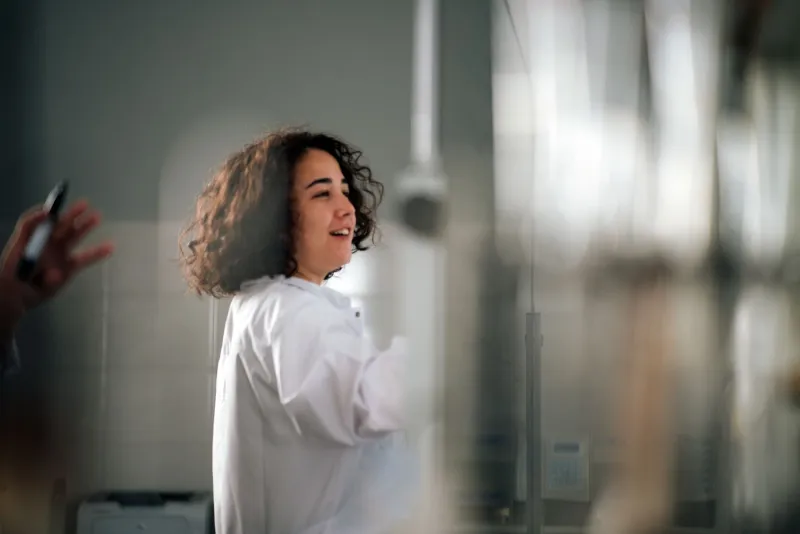
Beyond equipment and process, the people conducting Arizona's research are among the most powerful visual assets available to research institutions. Faculty portraits, graduate student profiles, and team photography all serve the recruitment and public engagement functions that institutional communications departments manage. But the most effective researcher photography moves beyond the conventional headshot format to place scientists within their working environments in ways that convey both personal character and professional context.
A computational biologist photographed at a workstation surrounded by genomic data visualizations communicates expertise in a way that a studio portrait cannot. A materials scientist photographed mid-experiment in a clean room environment, suited in the protective garments that the environment requires, projects a sense of precision and rigor that speaks directly to the concerns of potential research partners and funders. These environmental portraits are the visual equivalent of a well-crafted professional biography—they tell a story rather than simply recording an appearance.
For Arizona's biotech companies, researcher and team photography serves an additional function: it humanizes organizations that might otherwise appear opaque to the public audiences whose trust they need to earn. A Tempe-based gene therapy startup competing for attention in a national funding landscape benefits enormously from photography that presents its team as accomplished, engaged, and mission-driven professionals working toward outcomes that matter.
Communicating Science to Non-Scientific Audiences
One of the most demanding creative challenges in scientific photography is producing imagery that serves both technical and general audiences simultaneously. Annual reports, university marketing materials, and institutional websites must appeal to prospective students who are making consequential decisions about graduate training, to donors who may have no scientific background, and to journalists whose coverage shapes public perception of the institution's work.
This requires photographers to think carefully about the compositional and narrative choices that make scientific imagery accessible without sacrificing accuracy. Depth of field decisions that draw the viewer's eye to the most significant element of a complex laboratory setup. Lighting choices that reveal the texture and detail of specialized equipment while maintaining a visual warmth that makes the environment feel inhabited rather than sterile. The inclusion of human subjects—researchers at work—that provide scale, context, and the emotional anchor that connects scientific activity to human purpose.
Arizona State University's work in solar energy research, the University of Arizona's internationally recognized astronomy and optical sciences programs, and the growing cluster of precision medicine companies operating in the Phoenix biomedical district all represent scientific endeavors with genuine public resonance. Professional photography that captures these programs with accuracy and visual intelligence gives institutions the tools to engage public audiences who might otherwise remain unaware of the research being conducted in their own communities.
Photography as a Recruitment Tool in a Competitive Talent Market
The competition for scientific talent is among the most intense in any professional sector. Doctoral candidates and postdoctoral researchers choosing between institutional offers weigh facility quality, research culture, mentorship opportunity, and career development infrastructure—factors that photography can communicate with remarkable efficiency.
When a prospective graduate student encounters a university's recruitment materials, the photography they encounter shapes their initial impression of the institution's research environment before they have read a single word of program description. High-quality laboratory photography that conveys modern equipment, active research culture, and a professional working environment signals institutional investment in a way that written descriptions struggle to achieve.
For Arizona's research institutions competing against established programs in California, Massachusetts, and Texas, professional scientific photography is one of the most accessible tools available for closing the perception gap that can disadvantage newer or less nationally prominent programs. The quality of the imagery signals the quality of the institution—and in a recruitment environment where first impressions carry significant weight, that signal matters enormously.
Arizona's research community is producing science that deserves to be seen. The photographers who specialize in making that science visible are providing a service that extends well beyond aesthetics—they are helping to build the institutional visibility that sustains the funding, talent, and public confidence on which Arizona's knowledge economy depends.