Voltage, Vision, and Verification: How Arizona's Utility and Energy Companies Use Specialized Photography to Demonstrate Safety and Drive Public Confidence
Arizona residents flip switches, open taps, and charge electric vehicles without pausing to consider the vast, interconnected systems that make those actions possible. Substations hum quietly behind chain-link fences. Water treatment facilities process millions of gallons before dawn. Solar arrays stretch across the Sonoran Desert in configurations that would require a satellite view to fully appreciate. This is the invisible infrastructure of modern life — and for the utilities and energy companies that operate it, making that infrastructure visible is not merely a public relations exercise. It is a strategic imperative.
Specialized technical photography is emerging as one of the most effective tools available to Arizona's utility sector for communicating safety protocols, documenting operational excellence, and building the kind of public trust that sustains long-term investment in essential services.
The Challenge of Communicating Complexity
Utility and energy infrastructure presents unique photographic challenges that separate this discipline from conventional commercial work. The environments are often hazardous, access is tightly controlled, and the most critical elements of the work — the engineering decisions that prevent failures, the maintenance routines that extend equipment lifespan, the safety cultures that protect workers — are largely invisible to an untrained eye.
A skilled technical photographer working in this sector must do far more than document what is present. They must understand what they are looking at well enough to frame it in ways that communicate meaning to audiences ranging from state regulators and institutional investors to neighborhood residents attending a public information meeting. That requires genuine familiarity with industrial environments, adherence to strict safety protocols, and the compositional intelligence to find the human and operational story within a landscape of steel, conduit, and concrete.
In Arizona, where summer heat regularly exceeds 110 degrees Fahrenheit and where utility infrastructure must perform under some of the most demanding environmental conditions in the continental United States, that story is particularly worth telling.
Safety Documentation as Strategic Asset
For regulated utilities, photographic documentation of safety procedures serves purposes that extend well beyond internal record-keeping. When the Arizona Corporation Commission reviews operational practices, when OSHA conducts inspections, or when a utility seeks public approval for a rate adjustment or infrastructure expansion, visual evidence of rigorous safety culture carries substantial weight.
Professional photography captures technicians in full personal protective equipment working at correct distances from energized equipment. It documents the lockout/tagout procedures that prevent accidental energization during maintenance. It records the condition of transmission lines, transformer banks, and distribution infrastructure before and after service — creating a visual maintenance record that supports both regulatory compliance and internal quality assurance.
This documentation is not incidental. It is, in many respects, the most durable evidence a utility can produce of its operational standards. When incidents occur — as they inevitably do in any large-scale infrastructure operation — a comprehensive photographic record can demonstrate that proper protocols were followed and that the organization maintains the standards it publicly espouses.
The Renewable Energy Narrative in the Arizona Desert
Perhaps nowhere is technical photography more strategically significant than in Arizona's rapidly expanding renewable energy sector. The state's solar resource is among the finest in the world, and utility-scale solar development has accelerated dramatically over the past decade. Wind energy installations in the high desert and mountain corridors add further complexity to a generation portfolio that is transforming at historic speed.
For the companies developing and operating these facilities, photography serves multiple audiences simultaneously. Community stakeholders want reassurance that large-scale solar installations are managed responsibly and that the land surrounding them remains ecologically viable. Investors and lenders want visual confirmation that assets are being maintained to the standards that protect their capital. Corporate sustainability teams need imagery that substantiates the environmental claims made in annual reports and ESG disclosures.
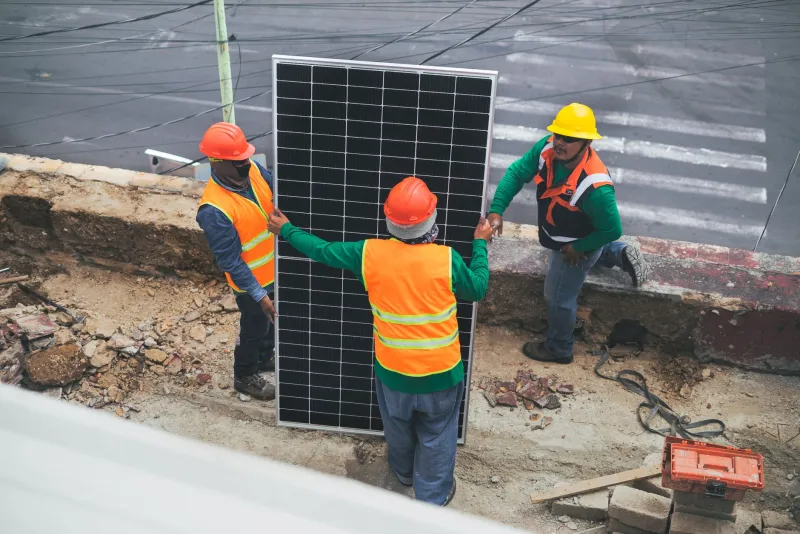
Aerial photography — conducted by licensed drone operators familiar with the airspace restrictions common around utility infrastructure — provides perspectives that ground-level documentation cannot. A solar array photographed from altitude reveals the precision of panel alignment, the integrity of fencing and perimeter controls, and the relationship of the facility to surrounding terrain in ways that communicate both scale and operational discipline. Paired with close-range imagery of inverter stations, monitoring equipment, and maintenance personnel at work, this multi-scale visual approach produces a comprehensive narrative of how modern renewable energy facilities actually function.
Water Utilities and the Invisible Lifeline
Arizona's water infrastructure faces challenges that are, if anything, more urgent than those confronting its electricity providers. In a state defined by desert geography and complicated by decades of rapid population growth, the systems that capture, treat, store, and distribute water represent an engineering achievement of the first order — and one that most residents take entirely for granted.
Municipal water utilities and regional water authorities have discovered that photography offers a powerful means of changing that dynamic. Images of treatment plant operations, aquifer recharge facilities, and distribution system maintenance humanize infrastructure that otherwise exists only as a monthly bill. When a utility is seeking voter approval for a bond measure or public support for a conservation initiative, the ability to show — rather than merely describe — the complexity and care involved in water delivery builds credibility that no infographic or press release can replicate.
Photography that captures water professionals at work, that shows the scale of storage reservoirs against the surrounding desert landscape, and that documents the precision of chemical treatment processes communicates a clear message: this is serious work, performed by serious people, on behalf of a community that depends on it absolutely.
Building Investor Confidence Through Visual Evidence
Beyond public communication, technical photography plays an increasingly important role in the capital markets that fund infrastructure development. Private equity firms, infrastructure funds, and institutional lenders evaluating Arizona energy and utility assets want visual due diligence alongside financial modeling. A comprehensive photographic survey of a facility's condition — conducted by a professional who understands what to look for and how to frame it — provides investors with evidence that the asset they are considering matches its written description.
This application of technical photography is growing as clean energy investment accelerates. A solar developer seeking financing for a new utility-scale project in the Phoenix metro area or along the I-10 corridor may commission a professional photographic survey of comparable operating facilities as part of the offering memorandum — providing prospective investors with visual confirmation of construction quality, maintenance standards, and operational maturity.
The Discipline Behind the Frame
What distinguishes professional technical photography in the utility and energy sector from general industrial work is the degree of preparation required before a single image is captured. Safety briefings, site-specific hazard assessments, coordination with operations personnel, and compliance with utility-specific access protocols all precede the moment when the camera is raised.
For Arizona's utility and energy companies, that preparation is not an inconvenience — it is the foundation of a productive working relationship with a photographer who understands that the images produced must be as reliable as the infrastructure they document. In an industry where public trust is both perpetually essential and perpetually fragile, that reliability is not a minor consideration.
It is, in fact, the entire point.